Cutcraft / Workshop planning
Can the offcuts you already have fit this job?
Before choosing boards, put the required part lengths, available stock and usable offcuts in one plan. Count the blade’s cut width and end trim as well as the finished parts.
This fictional one-dimensional example uses lengths only. It does not plan sheet layouts, structural strength, grain, defects or safe machine setup.
1. Enter the full job
Use millimetres, the material goal, 3 mm kerf, 6 mm total trim per used stock piece and a 150 mm reusable-remainder threshold. These are example assumptions; measure and choose values for your own materials and equipment.
| Item | Length | Quantity |
|---|---|---|
| Upright | 720 mm | 4 |
| Crosspiece | 480 mm | 6 |
| Brace | 315 mm | 4 |
| New board | 2400 mm | 5 available |
| Existing offcut | 960 mm | 2 available |
The example project contains these inputs. Cutcraft’s built-in sample also contains them. The requested finished parts total 7,020 mm across fourteen parts.
2. Generate and inspect the candidate
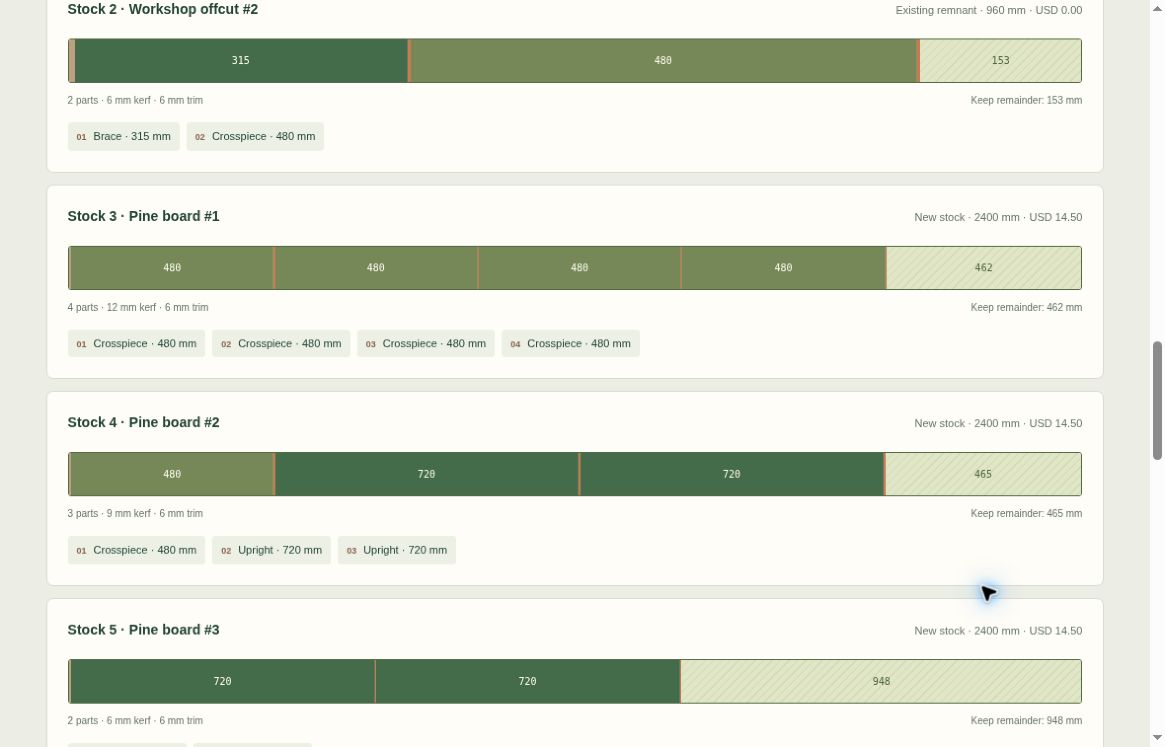
Select Generate cutting plan. The tool compares six heuristics. For this input, the selected Tight fit · shortest first candidate fulfills all fourteen parts using three new boards and both offcuts.
| Stock | Parts | Remainder |
|---|---|---|
| 960 offcut | 315 + 315 + 315 | 0 |
| 960 offcut | 315 + 480 | 153 |
| 2400 board | 480 + 480 + 480 + 480 | 462 |
| 2400 board | 480 + 720 + 720 | 465 |
| 2400 board | 720 + 720 | 948 |
The first offcut fits exactly under the tool’s model: 945 mm of parts + 9 mm of kerf + 6 mm of trim = 960 mm. The model conservatively counts one kerf per finished part, including the last part.
3. Account for every millimetre
Used stock:        9,120 mm
Finished parts:    7,020 mm
Kerf:                 42 mm
Trim:                 30 mm
Remaining lengths: 2,028 mm
Total:             9,120 mm
All positive remainders in this candidate meet the 150 mm reuse threshold. They still occupy storage and may not suit your next job. Calling a remainder reusable is an input assumption, not a promise of future use.
4. Compare the job without offcuts
As a controlled second run, remove the two offcuts and keep every other input unchanged. The selected candidate uses four 2400 mm boards and fulfills fourteen parts. Its remaining lengths total 2,514 mm; kerf and trim total 66 mm.
In this example, including offcuts uses one fewer new board, but increases kerf-plus-trim from 66 to 72 mm because five stock pieces are used instead of four. That distinction matters: fewer new boards, less total stock used and less discarded length are different goals. No universal savings claim follows from this example.
Before making a cut
- Check every requested quantity is fulfilled; inspect any unfulfilled parts.
- Verify actual stock lengths, defects, material suitability and cutting tolerances.
- Use kerf and trim values that match your process.
- Review each sequence and its remaining length before printing or exporting a cut list.
- Follow equipment instructions and safe workshop procedures.
“Best” means best among the six candidates compared. Cutcraft does not prove a global optimum. It is a 1D planning aid and cannot assess physical suitability or safety.